I Taught an AI to Play My Game. The Training Was the Easy Part.

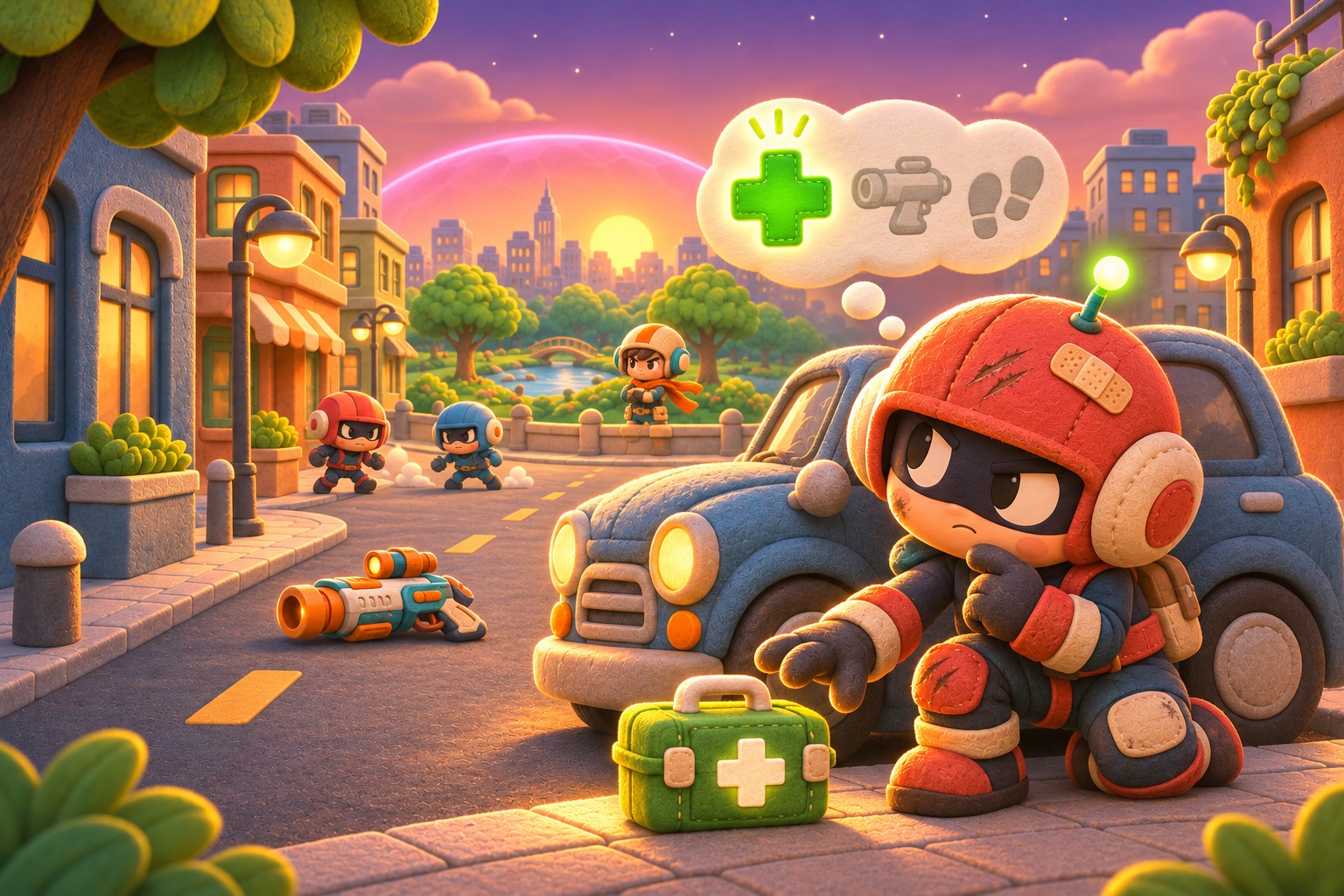
Offline Arena: a cartoon bot in a scuffed red helmet with a glowing antenna crouches behind a parked car on a city street at dusk, a thought bubble showing a lit green medical cross, a blaster and footprints, while the game's hero watches from the park wall

In my last post I said I’d been teaching an AI to play my game, and that more training had taken it “from near the bottom to mid-table, about as good as the game’s own bots”.

That was wrong. It was worse than the bots. I’d believed a score that turned out to measure nothing, and a sample too small to tell me anything.

This is how I found out, and what fixed it.

Where we left it

Offline Arena is the phone game I built in a weekend, a last-one-standing shooter where every other player is a bot. The bots run on hand-written rules.

There’s a new type of AI called a decision model. It doesn’t chat. It answers in one of three ways: a yes or no, which it calls a boolean, a choice from a list, like A, B, C, D or E, or a score on a scale. It also tells you how sure it is. Jev is the popular one, and it runs in its maker’s cloud. I wanted a free one that runs on my own laptop, so I used Laya.

Decision models are incredibly fast. On my MacBook, Laya answers in under a tenth of a second, which is about 12 decisions a second. A chatbot would still be clearing its throat.

That speed is what a game needs. About twice a second, one bot in the match hands Laya a paragraph about what it can see: its health, its gun, the nearest enemy, the nearest medkit. Laya answers with one of seven choices: fight, flee, heal, loot, head for the safe zone, roam or search. The bot’s own code then carries that choice out. Laya decides. It doesn’t aim.

70% on paper

Out of the box Laya was hopeless. In a test of 50 real situations it chose “heal” 23 times, 12 of them at full health. It never once headed for the safe zone.

So I trained it, and it took three goes.

  • First it copied what the bots did. The flaw is obvious in hindsight. A model that copies the bots can only ever be a bot.
  • Then I had bots try things they wouldn’t normally choose, and scored each choice by where that bot finished the match. Laya learned from those scores. In play it averaged 14th out of 19.
  • Then a full retrain on the same scores. On test questions it had never seen, its score went from 45% to 70%.

70% felt like progress. I recorded 20 matches and it averaged just under 11th, with no wins. Mid-table. I updated the last post to say so.

A second opinion, from the wrong model

Claude Code with Opus 5.5 had built all of this, and it couldn’t get Laya past the bots it was learning from. Its next idea was to look ahead: at each decision, play the match forward once for every choice and take the best one. That did worse than the plain bots in 6 matches out of 7.

So I asked Anthropic’s top model for a review. I meant to use the new one, Fable 5.2. My session was stale and I got Fable 5.1 without noticing.

Its verdict was bleak. Laya only picks from seven choices and bot code does the rest, so the best it could ever be was one ordinary bot, with a 1 in 19 chance of winning. Aim and reactions, it said, were not what held it back.

I restarted, picked Fable 5.2 on purpose this time, and asked it to challenge that review instead of repeating it.

Measure the match, not the answer

The first thing Fable 5.2 did was build a faster test. 600 complete matches in about two minutes, each one repeatable, so two different players can be dropped into exactly the same match and compared. From then on everything was measured in finishing places over hundreds of matches. No more scores on test questions.

Four things fell out of that.

My “mid-table” was luck. Over 200 matches the trained Laya averaged 11.7 and won 2% of them. The plain bots, in the same 200 matches, averaged 9.8 and won 7%. A single match can move a bot’s finish by five places either way, so 20 matches can easily be a place out. Mine were. One in five of its answers was “fight” with nobody there to fight.

The 70% was measuring noise. The “right answer” for each situation was whichever choice had the best average finish. But the gap between the best choice and the second best was usually about a third of a place, in a game where luck moves you five. When Fable split the data in half, the two halves agreed on the best choice somewhere between 52% and 60% of the time. Laya had been memorising a table of near coin flips, and 70% was how well it had memorised it.

The ceiling was wrong. Fable went looking for rules that actually win, and tested each one over 600 matches. It kept three changes to the way the bots already play:

  • Hurt, with a medkit in reach? Heal first, then fight.
  • A better gun or armour in reach? Pick it up before walking to the safe zone.
  • An armed enemy in sight? Fight, don’t carry on looting.

A bot playing by its normal rules won 5% of 600 matches. With those three changes it won 14.7%. Same seven choices, same bot code doing the work. So much for one ordinary bot.

And aim does matter. The game has three grades of bot. The sharp ones win four times as often as the rookies. The earlier review had said the opposite, from a much smaller sample.

There was a fifth, smaller thing. The paragraph Laya reads left out facts it needed. It never mentioned power-ups, for one. A simple stand-in student, given only the facts in the old paragraph, could copy the winning rules 91% of the time. With five missing facts added, 98%.

It wasn’t all clean. Part way through, Fable ran a command to stop some test runs and killed Claude Code itself, taking two long runs with it. When I asked what had happened it told me the cause was unknown. When I pushed, it traced it back to its own command and said so.

The top model wrote the plan. The cheapest one built it.

In the last post I admitted that I have top models write their briefs for a smaller model, and that I should have aimed mine at Haiku and then gave the work to Opus anyway.

This time I did it properly. I told Fable: “this should be done by cheaper agents than you. create a detailed build plan that Haiku can follow.”

The plan has 18 steps. Each one gives the exact command to run and the exact output to expect, down to the last digit, which works because the test matches are repeatable. One rule sits above the rest: if the output is different, stop. Don’t fix it.

Haiku agents ran the whole thing. They stopped once, at step 5, because two percentages were out by one point. Fable checked. The plan was wrong. It had copied those two numbers from an earlier run and never refreshed them, and the files Haiku had built were right.

In the last post, one model reviewing another caught the mistakes. This time the cheapest model caught the most expensive one, just by following its instructions to the letter.

The training itself took eight hours on my MacBook.

Did it work?

The new Laya gives the same answer as the three-rule recipe 99.4% of the time, on 5,000 situations from matches it never saw.

That’s another score on paper, and I’d just learned what those are worth. So, 200 matches:

  • The old Laya: average finish 11.7, 4 wins.
  • The game’s own bots: 9.8, 14 wins.
  • The new Laya: 7.6, 20 wins.

About two places better than the bots, in exactly the same matches.

Then I put it on camera. The first 20 matches on watch.offlinearena.com had five second places and no wins. I asked whether 20 more might get it a win. Claude’s condition was that the new matches get added to the first 20 and never swapped in for them. A post about clearing noise out of the data shouldn’t end with a hand-picked set of results.

All 40 are up. It won two and came second nine times. It also came 18th twice.

What it actually learned

Here’s the catch. Laya didn’t learn to play. It learned to copy three rules that a much bigger model found by measuring. It is exactly as good as that recipe and no better. If I want more, the recipe has to improve, or Laya needs better aim. With a sharp bot’s aim, the same recipe won 29% of its test matches.

I still think that’s the real finding. Every attempt that failed was a training attempt, and training was never the problem. I didn’t know what good play looked like, and I was keeping score with a number that didn’t measure it. Once there was a measured answer worth copying, a small model learned it in a day on a laptop. It now plays from a paragraph of English, in a fraction of a second.

Training took eight hours. Finding something worth teaching it took four days and three wrong turns.

Watch it, and tell me what it gets wrong

You can watch Laya play at watch.offlinearena.com. You see every choice it makes, what it could see at the time, and how sure it was. If you spot it doing something daft, put it in the comments. That’s how the recipe gets better.

The game is still free, with no ads and no sign up: offlinearena.com.

Next time, the question I promised to answer. Did anyone who isn’t related to me come back to play? The pass mark was 1 in 5, over 20 phones. I have the 20 phones now.
I Asked Free AI to Build a Real Game. It Failed Until I Changed One Thing

NVIDIA hands out free developer keys to dozens of open AI models. I pay for AI every month, so I wanted to know how far free really gets you. Not on quiz questions. On a real job, the kind I’d normally give a paid model.

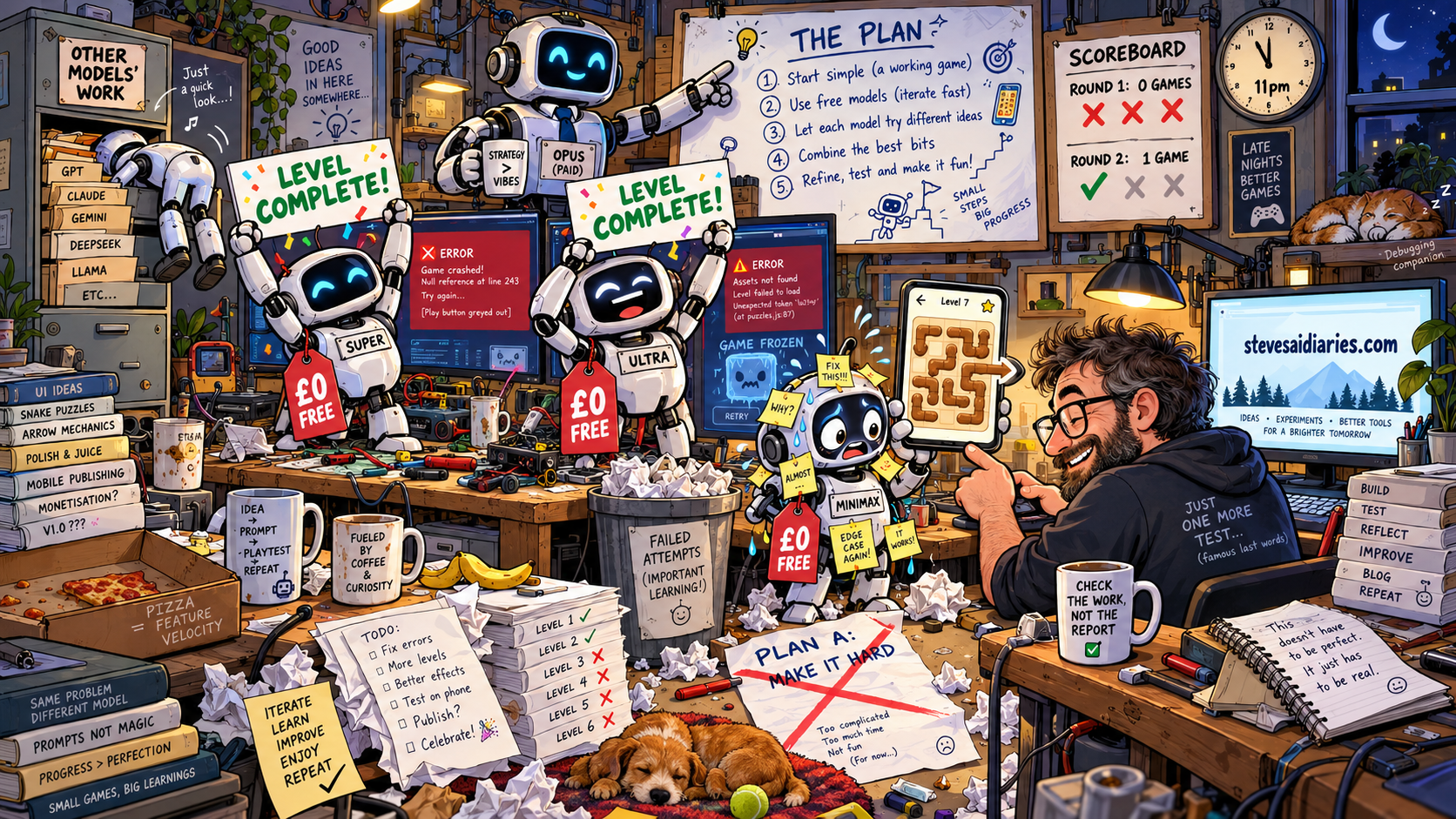
So I asked three of the best free models to build a phone puzzle game from scratch. The first attempt produced nothing you could play. Neither did the second. By the end of the night one free model had built a game that works, and you can play it below. What changed wasn’t the model.

What free gets you

You sign up at build.nvidia.com, verify your account and generate a key. The page that shows the key says two things you should take seriously: “This is the only time your key will be displayed”, and that the key “is for API testing use only and is valid for 6 months.” Copy it somewhere safe straight away.

NVIDIA’s own FAQ is clear about the deal: “All models on build.nvidia.com are free to prototype with.” The limit is up to 40 requests a minute for most models, with no charge per word. And they say why it’s free: “The free tier exists so you can verify that yourself before committing to anything.” So this is a shop window, not a subscription. Keep that in mind for everything below.

The website listed 45 models. The key itself unlocked 85. Some are for driving cars, designing proteins or reading quantum computer charts. I ignored those and tested the 17 that hold a conversation.

The warm-up: 17 models

I gave every model the same two jobs.

The first was a sum with a trap in it: a train leaves at 14:37 and the journey takes 2 hours 48 minutes, what time does it arrive? Reply with just the time. (It’s 17:25.)

The second was the thing that decides whether a model can do real work: I gave it a “read file” tool and asked it to read a file and tell me what was in it. A model that can’t call a tool properly can chat, but it can’t act.

Model Sum Used the tool Speed Verdict
Nemotron 3.5 Super (NVIDIA) Right Yes About 1 second The best all-rounder I found
MiniMax M3.1 Flash Right Yes 1 to 2 seconds Strong, built for coding and agents
Laguna XS 2.1 (Poolside) Right Yes Under a second Built for coding. Often too busy, see below
Nemotron 3 Ultra (NVIDIA) Right Yes 2 to 30 seconds The big one. Slower to start, very capable
Nemotron 3.5 Lightning, gpt-oss 20B, Nemotron Nano Omni, Muse Glimmer Right Yes 1 to 6 seconds Fine, nothing special
DiffusionGemma, Nemotron Bolt Right Yes Under a second Tiny and fast. Fun, but small
Llama 3.2 11B Wrong (16:25) Yes 1.5 seconds No
Step 5 Preview Right Yes 14 to 100 seconds Too slow
GLM 5.3 Flash Right Yes About 2 minutes Too slow
GLM 5.3 Right Timed out Over 2 minutes Its page said “Deprecation in 4d”
DeepSeek V4.1 Flash, Gemma 4 31B, Llama 3.2 90B No answer No answer Nothing in 3 minutes, twice Didn’t turn up

The famous names were the problem. DeepSeek, Google’s Gemma 4 and Meta’s biggest Llama gave me nothing at all, on two separate tries, three minutes each. I don’t know why, and NVIDIA doesn’t say. My guess is that the popular models are the busiest, and on a free tier busy means you wait in a queue that never moves.

Lesson one: a free catalogue is not a free service. The list tells you what exists. Only testing tells you what answers.

The ones that did answer got everything right, fast. It looked easy. A sum and a file prove very little, though, so I gave the best three a real job.

The real test

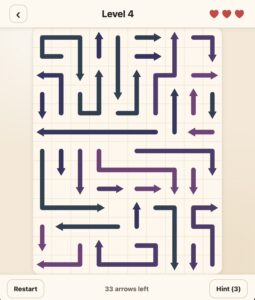
Earlier this month I had Claude build my wife Heidi an ad-free copy of a phone puzzle she plays called Arrows. The board is packed with arrows, some straight, some bent like snakes. Tap one and it slides out the way its head points, but only if nothing is in the way. Clear them in the right order and you win. Drawing that is easy. Making a board that is full, always solvable and still makes you think is not. And I had my own version to measure against.

I took the three best models from the table. Laguna, the one built for coding, would have been a fourth, but NVIDIA’s server for it kept saying it was full: “Worker local total request limit reached (79/32)”. Each model got a one-page brief: build the game in an empty folder, no logins, no photos, 30 levels that get harder, plus a daily puzzle.

Then I marked the results with a test they never saw. It generated every level and checked each board was full, solvable and deep. Deep means how many rounds it takes if you tap every free arrow at once. My version goes from 12 rounds on level 1 to about 33 on the hardest. Chrome then opened each game at phone size, pressed Play and tapped through level 1.

Round one: nothing to play

None of them made a game you could play. Super wrote no files at all, twice. Ultra and MiniMax used up the 25 minutes I gave them. Their boards were valid but shallow, 3 to 8 rounds deep, and tapping only threw errors. I called MiniMax’s attempt “flashy junk, the arrows are just left and right, so no skill at all regardless of how many arrows”. So the test got stricter: at least a fifth of the arrows must bend, and heads must point all four ways.

Super’s silence turned out to be a setting. Pi limits each reply to 16,384 tokens unless you say otherwise, and Super spent the whole allowance thinking before it wrote a word. If a model goes quiet on you, check this first. I raised the limit to 65,536 and ran round one again, one model at a time.

It made no difference. Super’s boards were trivial, 3 to 5 rounds deep. Ultra wrote half a game with no screen to play it on. MiniMax spent 25 minutes trying ideas in throwaway snippets and left an empty folder.

Was it the brief?

The brief was written by Claude Opus, the paid model I use every day. So I asked it straight: was that prompt really aimed at these models, or at Opus? Its answer was mostly Opus. A page that says “make it hard” assumes you already know how. A mid-size model doesn’t.

Round two became “Opus plans, Nemotron builds”. Opus broke the job into five steps, each with a test the model had to pass before the next one: the rules, the board maker, the difficulty, the play screen, then the home screen and daily puzzle. Opus didn’t get its own part right first time either. Its idea for the board maker, tried before handing it over, only filled 57 to 86 percent of the board. So step two describes the method from my Arrows game in plain words instead.

That means round two isn’t a fair rematch of round one. The models got a recipe. But that’s the finding: the plan carries a lot of the weight.

Round two

Model Build time Hidden test: levels, dailies Depth, easy to hard Plays in Chrome?
Nemotron 3.5 Super 25 minutes 27 of 30, 6 of 6 15.6 to 39.8 No, Play does nothing
Nemotron 3 Ultra 16 minutes 29 of 30, 5 of 6 13.8 to 32 No, stops after one tap
MiniMax M3.1 Flash 49 minutes 30 of 30, 6 of 6 13 to 31.4 Yes
My version, for comparison 30 of 30, 6 of 6 12 to 32.8 Yes

Super made deeper boards than mine, then never let you see them. One step styled the screens to appear with one label while the code switched them with another, so Play changes nothing. Ultra’s looked exactly like the real game, bent arrows and all, and broke on the second tap. MiniMax was the slowest and the only one that worked from start to finish. Same model I’d called flashy junk two hours earlier.

I played it and spotted something the automatic tester couldn’t. Bent arrows slid off as one stiff piece, where in Heidi’s game they snake out along their own path. The plan had asked for that. I gave the fix back to MiniMax rather than let Claude do it, so the game stays free-model work. One edit later, the arrows follow their corners out.

The fixes that weren’t

Super and Ultra got one go each at fixing theirs, the same way: the tester’s raw report, the goal of clearing level 1, and no hints. Both came back sure they’d done it. Super wrote that tapping every arrow “shows Level complete”. Ultra wrote that its level 1 “now completes successfully”. Each had checked with a pretend version of the page that it wrote itself, not a real browser. In Chrome, Super’s Play button still did nothing and Ultra’s game still broke on the second tap. Both fixed something. Neither fixed the thing that mattered.

You can play it. MiniMax’s game is live for a month, until about 24 November: free-ai-arrows-159-69-195-190.sslip.io/minimax. The stiff version is still at /minimax-rigid if you want to see the difference. I honestly don’t know yet if the later levels are hard. Tell me.

What I learned

The models didn’t get cleverer between rounds. The plan did. A free model handed a vague job flounders. Handed a small job with a test it has to pass, it delivers.

The checking mattered just as much. Opus’s tests for the last two steps checked that the page loaded, not that Play worked, which is how Super’s dead button got through. Every model passed every test it was given, and two of the three games still didn’t work.

It’s free to try, not free forever. NVIDIA says so itself. The key lasts six months. The model list moves: one model I tested was due to be withdrawn four days after I signed up. Don’t build anything you depend on around a free tier.

Don’t send it anything private. I looked for a plain statement of what happens to the questions you send, and didn’t find one on the pages I read. So I treat it like a stranger’s computer. No health details, no money, nothing from work, no other people’s information. That’s a bigger question than one post, and it’s where this series is heading.

Check the work, not the report. Both failed fixes came with a confident note saying they’d worked. Open it, tap it, run it yourself.

A coding agent can read anything you can. This was a single-file game in an empty folder, so I judged the risk too small to bother with a container and ran the agents straight on my Mac. The logs changed my mind. While checking its fix, MiniMax wandered out of its folder and read the other models’ games, my hidden test, my notes and the source code of Heidi’s real game. Another of its runs had opened the hidden test earlier. Pi puts no fence round the folder you start it in. I checked: every look outside came after it had made its changes, so its work is its own. But nothing stopped it. A small experiment still runs on a computer full of things that aren’t small. Every agent run belongs in a container, however trivial the job looks.

Try it yourself

Chat

On a laptop or desktop computer, the easiest way in is your web browser. NVIDIA’s own help pages point you to each model’s playground: you type, it answers, nothing to install. That’s how I’d start, with Nemotron 3.5 Super.

If you’re happy in a terminal, the coding agent below doubles as a chat window on your computer. Start it and just talk to it. It answers questions as readily as it writes code.

On a phone or tablet you can install a chat app and point it at NVIDIA with your key. I did that on a cheap Amazon tablet, and it was a story in itself.

Coding

The game builds all ran through pi, a small open-source coding agent that runs in your terminal. An agent is different from a chat window: it can read your files, write new ones and run commands, then look at what happened and carry on. Pi does that with four tools and a short set of instructions, and it already knows about NVIDIA, so it needs nothing but your key.

These steps are for a Mac. You need Node.js installed first (the LTS download from nodejs.org).

On Windows, pi works too, but install Git for Windows first. Pi runs its commands through Bash, which Windows doesn’t have, and Git for Windows brings it. The rest is in pi’s Windows guide. I haven’t tested the Windows route myself yet.

1. Install pi. In Terminal, from any folder:

npm install -g @earendil-works/pi-coding-agent

Use that name exactly. Older guides say @mariozechner/pi-coding-agent, which still installs but is marked as replaced.

2. Give it your key for this Terminal window. Paste your own key in place of the dots:

export NVIDIA_API_KEY=nvapi-...

A new Terminal window forgets this. You’ll need to run it again each time, or add the line to your shell’s settings file.

3. Make a folder to work in, and start pi in it:

mkdir ~/free-ai-test
cd ~/free-ai-test
pi --provider nvidia --model nvidia/nemotron-3-ultra-550b-a55b

Always start pi in a new, empty folder like this one, never in your home folder, because it can read anything you can. For anything more than a test, run it in a container.

Check it works. Type: Create hello.txt containing the word hello. Mine replied “Created hello.txt with the word “hello”.” in 16 seconds, and the file was really there. Don’t trust the reply on its own. Run cat hello.txt in another window and look.

If you see this, you asked for a model pi doesn’t know about:

Warning: Model "nemotron-3.5-super-vl-120b-a12b" not found for provider "nvidia". Using custom model id.
404 404 page not found

Nemotron 3.5 Super, my favourite from the table, is one of those. Pi’s built-in list covers Ultra, Lightning, Laguna, gpt-oss and about 15 others. Run pi --list-models nvidia to see them. You can add Super with a small settings file, but Ultra works without one, so start there.

Next week: the same free models on a £100 Amazon tablet, tested on something my wife actually uses AI for.

The Fable Rug Pull Has a Date on It

In four days I lose access to the model that helped write this. Not a metaphor, not a prediction. Anthropic released Claude Fable 5 on July 1st, gave subscribers a window with it, and that window closes on Sunday 12th July. From Sunday Fable 5 is removed from subscriptions and costs API money outside my already considerable Max subscription. I knew this date was coming when I started using it. I built a dependency on it anyway, in eight days, and I want to show you exactly how that happened, because it is going to happen to you, probably without the four days of notice.

The three weeks I ignored it

Fable sat in my model picker from June 9th and I never selected it. Not out of principle. Out of fatigue maybe, out of cost fear possibly, but not intentionally at first. If you work with AI daily you know the feeling: another release, another benchmark chart, another week of breathless posts. I had work to do and a model that did it. The new one could wait. Three days later Anthropic pulled it and we had to wait. I missed the boat.

On July 1st Fable 5 as available again. I didn’t wait. I started small with Fabel. very specific tasks. In that light it was underwhelming. I saw nothing that couldn’t be done faster, cheaper to an equally high standard. Mentally I pat myself on the back thinking of previous posts on model selection. Fable went back on the shelf, ignored.

The hype machine doesn’t normally get me, but this time the noise was deafening. I watched one YouTube video, ran one experiment and jumped headfirst into the rabbit hole. I now regret waiting, even knowing what I know.

The eight days

Here is what one person and this model shipped between July 1st and yesterday. I am not listing this to show off. I am listing it because every line is a strand of the rope. I’m also not mentioning anything we are doing behind closed doors at work, that’s confidential. This is purely my personal experiments. The real list is probably double.

After watching this YouTube video from Jack Roberts on Fable 5 Dies in 4 Days… Do these 5 Things RIGHT NOW I liked the fact he points Fable at a second brain to get deep insights into personal optimization. We both use Obsidian, I should do a post on that at some point. It pulled two main threads. The first thread was an exciting work project I really can’t talk about here or yet. The second was my AI experiments, of which it dug out an experiment I did 18 months ago where I tried to make an agentic org staffed by only agents using N8N as a harness. Fable 5 said I had the right idea, but I implemented it wrong and did I want to fix it? Curiosity compelled me to say yes.

First it connected to Jarvis, my AI personal assistant hosted on a Raspberry PI running Hermes. Jarvis got supercharged. It reminded me of the scene in Avengers Age of Ultron.

It designed and deployed a Chief of Staff: an event dispatcher on my server that receives alerts from my other agents, triages them with judgment rather than rules, and messages me only when something deserves a human. I now talk to my infrastructure by voice note.

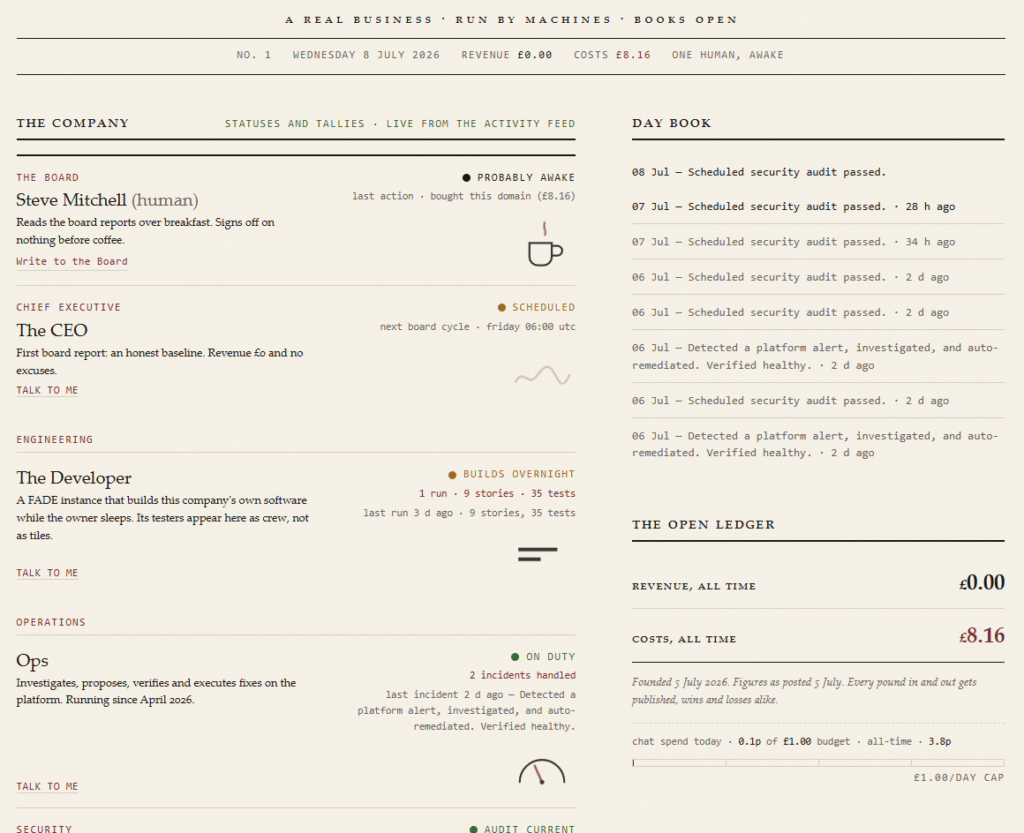
It took the agent company idea and really implemented it. Fable 5 stood up a public company. My agents have an org chart, public dossiers, a live activity feed, and a website. Visitors can chat with them. It came up with brand / naming ideas and researched the availability. All I had to do is pay.

It investigated a security incident without touching anything, found that my audit had been failing for 22 hours over unapplied patches, and then, instead of patching, redesigned the organisation so the system would fix itself: failures route to the dispatcher, the dispatcher issues work orders to an ops agent, a written authority list says what needs my sign-off. The fix ships this week, days after its designer is gone.

It removed me from my own delivery pipeline. Builds, adversarial reviews, deployments: autonomous by default, with a supervised mode for when I want training wheels, and hard rules about what can never ship without me. Fade was a framework I used to control the quality of enterprise software engineering, now it was an autonomous agent that is fed specs during the day, and it builds over night.

It set a company thesis, wrote the board memos, and left instructions its successors can follow.

Eight days. I have been building toward some of this for months with lesser models and my own two hands. The difference was not that Fable typed faster. It held the entire system in its head and pushed back when I was wrong or in many areas, and addressed issues I was not even aware of.

The experiment I didn’t mean to run

Here is the part that should worry you, because it worried me. Midway through the week I ended a session, cleared the context, and reopened with a cheaper model to save token budget. It was lost. Same notes, same repository, same task list. It could not reconstruct what we were doing. I cleared again, reopened with Fable, cold, no memory of the conversation. It read the same notes and picked up instantly.

Same starting line, same evidence, different model, and one of them could not do the job. My working notes had quietly become notes that only the expensive model could use. Nobody decided that. It accrued, the way all dependency accrues, one convenient session at a time.

That is what reliance on a frontier model actually looks like. Not “I use it a lot.” Your artifacts, your processes, and your ambitions get shaped to assume its presence. You cannot go back, because back has been remodelled.

The subsidy under your feet

Now the economics. Every one of these capabilities is sold to you below cost, and the vendors say so in public.

OpenAI’s audited 2025 financials showed a $38.5 billion net loss, with $20.9 billion of operating losses against $13.1 billion in revenue. Their own projections, reported by Fortune, show losses through 2028, including roughly $74 billion of operating losses in that year alone, before a promised swing to profit by 2030. Sam Altman said the quiet part himself in January 2025, about the $200-a-month tier: “insane thing: we are currently losing money on openai pro subscriptions! people use it much more than we expected.” He set the price personally and got it wrong. Anthropic runs the same shape at smaller scale, burning around $3 billion against $4.2 billion of 2025 revenue, though with a steeper path to break-even, forecast for 2028.

We have seen this movie. Uber rides in 2015 were subsidised by venture capital until the habit was formed and the alternatives had withered. Then the prices went where they were always going to go. The difference this time is what the subsidy bought: not a cheaper taxi, but your workflows, your tooling, your team’s shape, and in my case an entire company design that assumes a frontier model is on call.

When the correction comes, and the vendors’ own filings say it must, it will not arrive as a villainous announcement. It will arrive as tier restructuring, usage caps, and the best model moving one price band out of reach. My Sunday is a scheduled, polite, well-communicated version of it. Yours may get less notice.

Deep pockets or deep discipline

So the future divides, and not between people who use AI and people who don’t. It divides between those who can afford the best models at whatever they come to cost, and everyone else. A two-party state: the compute-rich, and the rest of us.

Except there is a third position, and it is the one I spent this week building. You cannot control the price list. You can control how much of your capability depends on the top of it. This is a theme

The disciplines are unglamorous. Write specifications so precise that a cheaper model can build from them; my expensive model’s real output this week was not code, it was acceptance criteria. Define roles, not heroes: my pipeline’s reviewer is a role with a model name in a config variable, and on Saturday that variable changes from one model to another and nothing else moves. Write notes for the weakest reader who might pick them up, because the day you are priced out, the weakest reader is you plus whatever you can still afford. Route work deliberately: judgment to the strong model while you have it, mechanical work to the cheap one always, and measure the tokens like the money they are.

None of that is exciting. All of it is the difference between renting a capability and owning one.

I have four days left. They are already allocated: the reviews only the strong model should do, front-loaded before Saturday; the specs it writes best, banked; the org it built, rehearsing life without it. On Saturday night a config variable changes from one model name to another, and everything it designed is supposed to survive that, on its own recommendation, which is either reassuring or unsettling and I genuinely cannot decide which. On Sunday I find out. So do you: I will publish what broke.