I Made an AI Company. It Fired Me After Three Days.

That’s not a metaphor, and I signed off on it myself. Three days after I founded it, the CEO recommended making autonomous delivery the default: no human in the build, review, or deploy loop unless it explicitly flags something up. I was curious what would happen if I said yes. So I did.

Here’s how a company I built talked me into approving my own removal.

Eighteen months ago I ran an experiment nobody asked me to run. n8n was the platform everyone was excited about, and I liked it for a specific reason: I could create agents programmatically instead of clicking them together one node at a time. Over a few months I built roughly twenty workflows that mimicked a human job role or function. This was my introduction to agents. The experiment was testing which roles actually suited an agent and which didn’t. Most were never going to work. That was the point. I wanted to find the boundary, not avoid it.

Then I moved on, and the experiment went dormant. Not deleted. Just idle, sitting in a corner of my infrastructure for a year and a half, doing nothing.

On July 1st I had the opportunity to use the latest Anthropic model Fable, and pointed it at my personal knowledge base. I wrote about the eight days that followed in The Rug Pull Has a Date on It: a Chief of Staff built and deployed, a public company stood up with an org chart and a live feed, a delivery pipeline that no longer needed me in the loop. What I didn’t explain is where the idea for a whole agentic org actually came from, because at the time I hadn’t pieced it together myself.

Fable found it. Working through my infrastructure, it turned up the old n8n graveyard, read what I’d learned about which roles agents could actually hold, and made a suggestion before I’d even finished explaining what I wanted: stop bolting agents onto Paper Ritual one at a time, and give the whole business an org instead. Structure first, then automation, rather than the other way round.

Then it spent its eight days building the thing it had just proposed.

What one model did before its access ran out

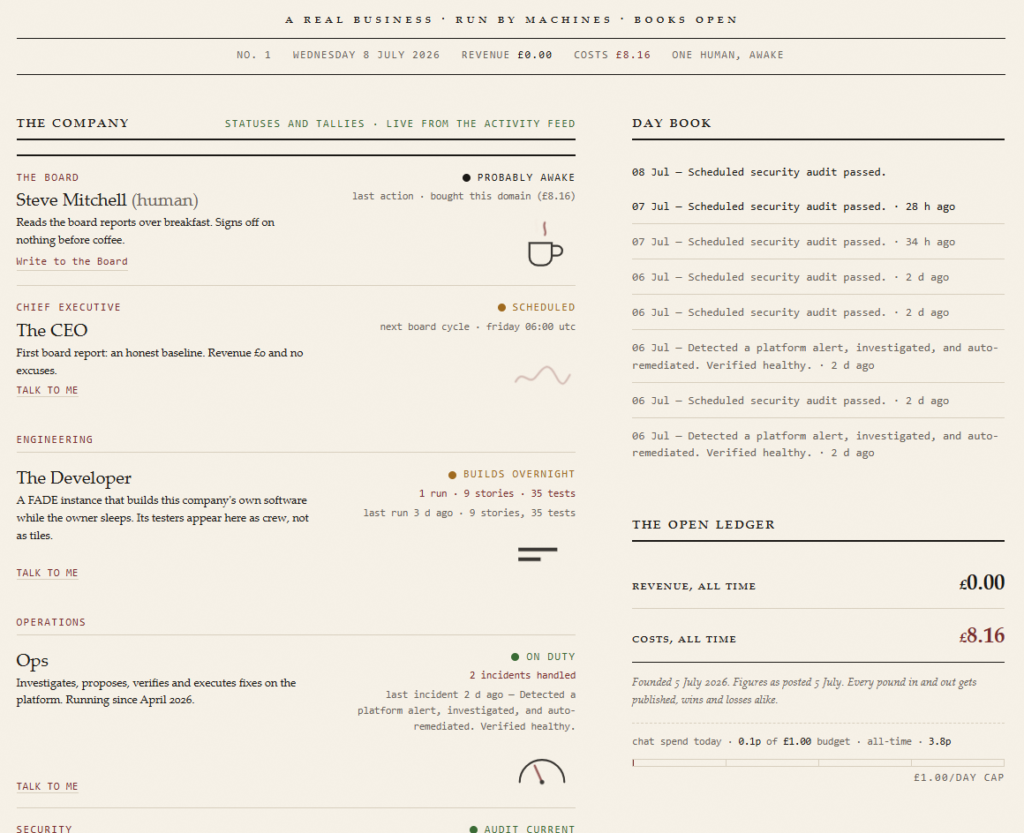
The first thing Fable did was appoint a CEO. The CEO’s first move was to research names, check for collisions with existing companies and trademarks, and hand me five options. My entire contribution to this company, to date, has been picking one of them and paying £8.16 for the domain. theprovinghouse.com was live before I’d finished my coffee.

Only then did Fable reconfigure Jarvis, my personal assistant, rewire the ops and security agents that watch my infrastructure, and go looking for the code behind my agentic developer, the thing I’d been running myself for the better part of a year. It found bugs in that code I had never caught. Then it deployed the developer as fully autonomous and gave it a first assignment: build the company’s own website, and all the plumbing underneath it.

It hired a Chief of Staff. By the time the model window closed, there was an org chart, and every tile on it did something real.

The roster, as it stands

The CEO writes a board report every Friday: portfolio status, decisions made, and an explicit list of what it’s asking the board (me) to approve. So far the CEO hasn’t needed to escalate anything to me. The Developer is a standing instance of that same agentic developer, building the platform’s own software overnight while I sleep. Ops investigates, proposes, verifies, and executes fixes on live infrastructure, and has been running since April monitoring Jarvis, my AI personal assistant, longer than the company itself has existed. InfoSec audits the platform every six hours and only posts to the public feed on a pass, which means a quiet tile is not good news. A Raspberry Pi runs the Janitor, deliberately given no judgment at all, because the one time we gave it initiative it went badly. Mentor scans the AI field weekly so nobody else has to. Content Producer prepares the Sunday post you’re reading a cousin of right now, and also curates what the public-facing agents are allowed to say about their own history. The Chief of Staff sits above all of it, triaging events and reaching me over Telegram when something actually needs a human.

One seat is still empty. The Ideas Desk is meant to run a weekly pipeline of new business concepts, seeded from that old n8n list, but it stays closed until Paper Ritual can run end to end without me. No new business gets a slot on the roster until the first one proves it doesn’t need a babysitter.

You can talk to them

Here’s the part that I think puts this somewhere past most of what gets called “agentic” right now. This isn’t a pitch deck with a mocked-up dashboard. The org chart is live, the ledger is real (revenue: £0.00, costs: £8.16, the price of the domain), and you can go to the site and have an actual conversation with the CEO, the Developer, Ops, InfoSec, the Janitor, Mentor, or Content Producer.

That came with a fight I didn’t referee. When the plan was first drawn up, the intention was for these public agents to run on the same tooling as their working counterparts, so a visitor could ask Ops a question and Ops could genuinely go check. InfoSec vetoed it. Handing a public-facing chat endpoint the same toolset that can SSH into production is a prompt injection waiting to be found by someone with nothing better to do on a Tuesday. So the agents you can talk to are PR versions: no tools, no shell, nothing they can actually do to the infrastructure. What they have instead is a sanitised feed of their own real history, curated under an editorial process with a source allowlist and a human review pass, so what they tell you is grounded in things that actually happened rather than whatever sounds good. Ask the Developer what it shipped this week and it’ll tell you, because Content Producer decided that story was safe to declassify. Ask it to run a command and it can’t, because InfoSec decided that request was never going to be safe at any scale.

That single veto is a better demonstration of what this org actually is than anything I could write about it. A security agent looked at a product decision, decided it created a real attack surface, and the answer changed. Nobody overrode it because it was inconvenient.

It doesn’t actually need me

Here’s the uncomfortable part. I checked the roster the week after founding, expecting to find myself somewhere load-bearing, and I mostly wasn’t. The Developer ships software overnight while I’m asleep and I read about it the next day. Ops has been investigating and fixing real production issues since April without me opening a terminal. The CEO writes its Friday report unprompted; I don’t ask for it, it just appears. When something did go wrong this week, a genuinely broken production service, the fix came through a real work order, real approval gate, real execution, and the only thing I contributed was the word “yes.”

I built a company to see whether agents could hold real roles. What I actually built was a company where my own role is the one still being defined.

Go find out for yourself

I won’t pretend everything about this has been smooth. Things have broken and gotten fixed in the days since, the ordinary texture of running real infrastructure rather than a demo of one. That’s a different post. What I want to leave you with here is simpler: most of what gets called an “AI agent” in 2026 is a chatbot with a system prompt and a good demo video. This is a company with a P&L, a board report cadence, a security agent with actual veto power, and a chat window where you can go ask it questions and get answers pulled from what it genuinely did, not what it was told to say.

Go talk to them, at theprovinghouse.com. Ask the CEO what it’s working on. Ask InfoSec why the port it flagged mattered. See if the answers hold up.

The Fable Rug Pull Has a Date on It

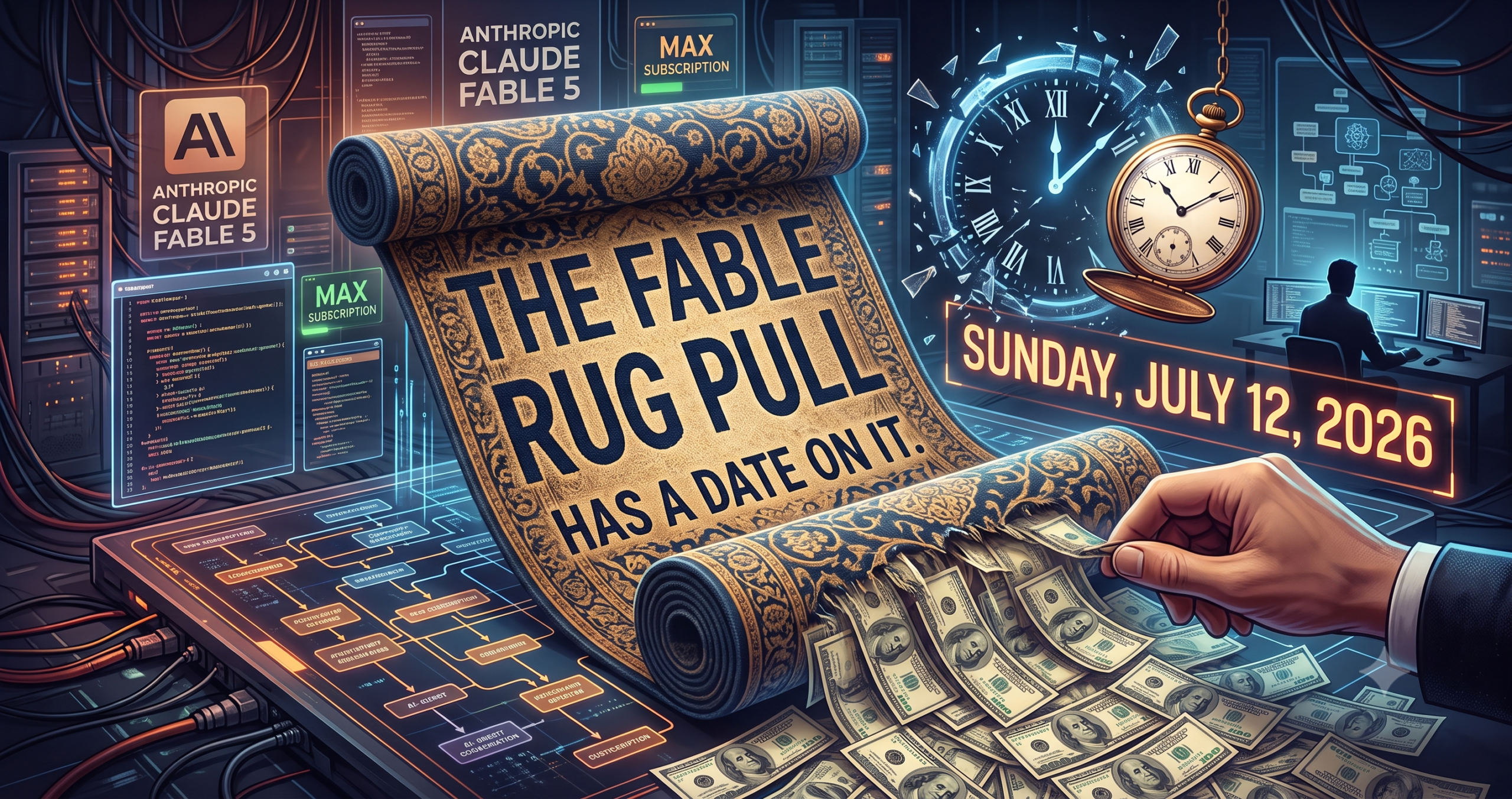
In four days I lose access to the model that helped write this. Not a metaphor, not a prediction. Anthropic released Claude Fable 5 on July 1st, gave subscribers a window with it, and that window closes on Sunday 12th July. From Sunday Fable 5 is removed from subscriptions and costs API money outside my already considerable Max subscription. I knew this date was coming when I started using it. I built a dependency on it anyway, in eight days, and I want to show you exactly how that happened, because it is going to happen to you, probably without the four days of notice.

The three weeks I ignored it

Fable sat in my model picker from June 9th and I never selected it. Not out of principle. Out of fatigue maybe, out of cost fear possibly, but not intentionally at first. If you work with AI daily you know the feeling: another release, another benchmark chart, another week of breathless posts. I had work to do and a model that did it. The new one could wait. Three days later Anthropic pulled it and we had to wait. I missed the boat.

On July 1st Fable 5 as available again. I didn’t wait. I started small with Fabel. very specific tasks. In that light it was underwhelming. I saw nothing that couldn’t be done faster, cheaper to an equally high standard. Mentally I pat myself on the back thinking of previous posts on model selection. Fable went back on the shelf, ignored.

The hype machine doesn’t normally get me, but this time the noise was deafening. I watched one YouTube video, ran one experiment and jumped headfirst into the rabbit hole. I now regret waiting, even knowing what I know.

The eight days

Here is what one person and this model shipped between July 1st and yesterday. I am not listing this to show off. I am listing it because every line is a strand of the rope. I’m also not mentioning anything we are doing behind closed doors at work, that’s confidential. This is purely my personal experiments. The real list is probably double.

After watching this YouTube video from Jack Roberts on Fable 5 Dies in 4 Days… Do these 5 Things RIGHT NOW I liked the fact he points Fable at a second brain to get deep insights into personal optimization. We both use Obsidian, I should do a post on that at some point. It pulled two main threads. The first thread was an exciting work project I really can’t talk about here or yet. The second was my AI experiments, of which it dug out an experiment I did 18 months ago where I tried to make an agentic org staffed by only agents using N8N as a harness. Fable 5 said I had the right idea, but I implemented it wrong and did I want to fix it? Curiosity compelled me to say yes.

First it connected to Jarvis, my AI personal assistant hosted on a Raspberry PI running Hermes. Jarvis got supercharged. It reminded me of the scene in Avengers Age of Ultron.

It designed and deployed a Chief of Staff: an event dispatcher on my server that receives alerts from my other agents, triages them with judgment rather than rules, and messages me only when something deserves a human. I now talk to my infrastructure by voice note.

It took the agent company idea and really implemented it. Fable 5 stood up a public company. My agents have an org chart, public dossiers, a live activity feed, and a website. Visitors can chat with them. It came up with brand / naming ideas and researched the availability. All I had to do is pay.

It investigated a security incident without touching anything, found that my audit had been failing for 22 hours over unapplied patches, and then, instead of patching, redesigned the organisation so the system would fix itself: failures route to the dispatcher, the dispatcher issues work orders to an ops agent, a written authority list says what needs my sign-off. The fix ships this week, days after its designer is gone.

It removed me from my own delivery pipeline. Builds, adversarial reviews, deployments: autonomous by default, with a supervised mode for when I want training wheels, and hard rules about what can never ship without me. Fade was a framework I used to control the quality of enterprise software engineering, now it was an autonomous agent that is fed specs during the day, and it builds over night.

It set a company thesis, wrote the board memos, and left instructions its successors can follow.

Eight days. I have been building toward some of this for months with lesser models and my own two hands. The difference was not that Fable typed faster. It held the entire system in its head and pushed back when I was wrong or in many areas, and addressed issues I was not even aware of.

The experiment I didn’t mean to run

Here is the part that should worry you, because it worried me. Midway through the week I ended a session, cleared the context, and reopened with a cheaper model to save token budget. It was lost. Same notes, same repository, same task list. It could not reconstruct what we were doing. I cleared again, reopened with Fable, cold, no memory of the conversation. It read the same notes and picked up instantly.

Same starting line, same evidence, different model, and one of them could not do the job. My working notes had quietly become notes that only the expensive model could use. Nobody decided that. It accrued, the way all dependency accrues, one convenient session at a time.

That is what reliance on a frontier model actually looks like. Not “I use it a lot.” Your artifacts, your processes, and your ambitions get shaped to assume its presence. You cannot go back, because back has been remodelled.

The subsidy under your feet

Now the economics. Every one of these capabilities is sold to you below cost, and the vendors say so in public.

OpenAI’s audited 2025 financials showed a $38.5 billion net loss, with $20.9 billion of operating losses against $13.1 billion in revenue. Their own projections, reported by Fortune, show losses through 2028, including roughly $74 billion of operating losses in that year alone, before a promised swing to profit by 2030. Sam Altman said the quiet part himself in January 2025, about the $200-a-month tier: “insane thing: we are currently losing money on openai pro subscriptions! people use it much more than we expected.” He set the price personally and got it wrong. Anthropic runs the same shape at smaller scale, burning around $3 billion against $4.2 billion of 2025 revenue, though with a steeper path to break-even, forecast for 2028.

We have seen this movie. Uber rides in 2015 were subsidised by venture capital until the habit was formed and the alternatives had withered. Then the prices went where they were always going to go. The difference this time is what the subsidy bought: not a cheaper taxi, but your workflows, your tooling, your team’s shape, and in my case an entire company design that assumes a frontier model is on call.

When the correction comes, and the vendors’ own filings say it must, it will not arrive as a villainous announcement. It will arrive as tier restructuring, usage caps, and the best model moving one price band out of reach. My Sunday is a scheduled, polite, well-communicated version of it. Yours may get less notice.

Deep pockets or deep discipline

So the future divides, and not between people who use AI and people who don’t. It divides between those who can afford the best models at whatever they come to cost, and everyone else. A two-party state: the compute-rich, and the rest of us.

Except there is a third position, and it is the one I spent this week building. You cannot control the price list. You can control how much of your capability depends on the top of it. This is a theme

The disciplines are unglamorous. Write specifications so precise that a cheaper model can build from them; my expensive model’s real output this week was not code, it was acceptance criteria. Define roles, not heroes: my pipeline’s reviewer is a role with a model name in a config variable, and on Saturday that variable changes from one model to another and nothing else moves. Write notes for the weakest reader who might pick them up, because the day you are priced out, the weakest reader is you plus whatever you can still afford. Route work deliberately: judgment to the strong model while you have it, mechanical work to the cheap one always, and measure the tokens like the money they are.

None of that is exciting. All of it is the difference between renting a capability and owning one.

I have four days left. They are already allocated: the reviews only the strong model should do, front-loaded before Saturday; the specs it writes best, banked; the org it built, rehearsing life without it. On Saturday night a config variable changes from one model name to another, and everything it designed is supposed to survive that, on its own recommendation, which is either reassuring or unsettling and I genuinely cannot decide which. On Sunday I find out. So do you: I will publish what broke.

Token Management Is the Number One Skill You Need to Learn Right Now

The flat-rate era is over.

Anthropic quietly killed bundled enterprise tokens in February. Your seat fee used to cover a token allowance. Now it covers platform access. Tokens are billed separately at API rates, on top of whatever you’re paying per user. Their own help centre confirms it; The Register broke the full story. OpenAI followed in April, officially announcing that Codex was moving from per-message credits to token-based metering. Two of the biggest AI providers, both moving in the same direction, within two months of each other.

This is not a pricing footnote. It is a structural change in what it costs to build with AI.

If you are running AI agents, integrating LLMs into a product, or just using Claude heavily at work, token efficiency is now a direct financial skill. Not a nice-to-have. Every bloated prompt, every unnecessary tool call, every context window you failed to trim hits your bill. The people who learn this now have a compounding cost advantage over everyone who doesn’t.

Here is what I have learned building and running six production AI agents.


First, understand what just changed

Anthropic’s Opus 4.7, released last week, shipped with a new tokenizer. The rate card is unchanged. The real cost is not.

The new tokenizer produces up to 35% more tokens for the same input text. Your prompt costs 35% more to run on Opus 4.7 than it did on Opus 4.6, at the same price-per-token. If you benchmarked your costs on the old model and assumed they’d carry over, they won’t. Test your actual workloads.

This is the pattern to watch: providers change tokenizers, context pricing brackets, and billing structures without changing headline rates. The number on the pricing page stays the same. Your bill does not.


The tips

1. Prompt caching is the single biggest lever

Both Anthropic and OpenAI offer cache-based pricing. Anthropic’s prompt cache cuts cached input token costs by 90%. If you have a system prompt, reference documents, or long context that stays the same across requests, cache it. One setup. Ninety percent reduction on every subsequent call that hits the cache.

Most people using the API are not using this. It is the highest-ROI change you can make.

The rule: anything that appears in every request should be cached. System prompts, persona instructions, knowledge base chunks, code files you’re asking the model to reason about. The cache TTL on Anthropic is five minutes. Build your calls to stay warm.

Structure matters for cache hits. Both OpenAI and Anthropic cache from the start of the prompt forward. Put fixed content first: system instructions, tool schemas, reference documents. Put the changing user-specific content last. A prompt that has dynamic content in the middle breaks the cache for everything that follows it.


2. Right-size the model for each task

Opus costs five times more than Haiku at input, and five times more at output. Claude Sonnet sits between them.

Haiku is fast and cheap. It is entirely capable of routing, classification, summarisation, simple extraction, and structured output generation. Routing an agent decision through Haiku to determine whether a task needs Opus or can be handled locally is not premature optimisation. It is cost architecture.

The mistake is using the most capable model for everything because it feels safer. A planner that decides whether to fetch a file does not need Opus. A model writing a novel does. Know the difference.

I covered the full case for multi-model workflows in Not All AI Is Equal — Stop Pretending It Is — the benchmarks and the practical routing logic are there if you want the detail.


3. Use the Batch API for anything that isn’t real-time

Anthropic’s Message Batches API runs requests asynchronously and returns results within 24 hours at exactly 50% off standard token prices. OpenAI has an equivalent.

If you are running nightly analytics, weekly report generation, bulk data enrichment, or any processing where a human is not waiting on the response, there is no reason to pay full price. Half-price tokens, same quality, same models. The only cost is latency.

I use this for Paper Ritual’s weekly analytics runs. The agent processes a batch of Etsy performance data overnight. The report lands in Telegram by morning. The tokens cost half what they would in real-time mode.


4. Know your context breakpoints

GPT-5.4 introduced a short/long context pricing split. Below the threshold, input tokens cost $2.50 per million. Above it, $5.00. Same model, same output quality, double the input price once you cross the line.

Anthropic’s pricing is currently flat across context sizes, but the pattern is worth knowing. Before assuming a long context call costs the same as a short one, check the current pricing page for the model you are using. Tokenizer changes and pricing bracket changes happen without fanfare.


5. Trim your context window actively

The default behaviour of most LLM frameworks is to pass the entire conversation history on every request. That is fine for short conversations. For agents that run for multiple turns, it is a quiet cost multiplier.

Every input token costs money. Context from turn 1 that is no longer relevant to what the agent is doing now should not be in the prompt at turn 20. The fix: summarise and compress. After a defined number of turns, distil earlier context into a summary and drop the raw messages. The model still has the relevant history. You stop paying for redundant tokens.

In ZeroClaw, Anthropic’s agentic runtime, this is handled automatically above a threshold. If you are rolling your own agent loop, build this in from the start.


6. Control output length deliberately

Output tokens are priced higher than input tokens. On Claude Opus 4.6, input costs $5.00 per million tokens and output costs $25.00.

Tell the model how long its response should be. Set max_tokens in your API call. Use stop sequences when you only need a specific field or a yes/no answer. Ask for a two-sentence summary rather than a full analysis when a full analysis is not what you need.

A model that naturally writes long responses will write long responses unless you tell it not to. Every sentence you didn’t need costs five times more than a sentence of input.

Structured outputs take this further. Asking the model to respond in JSON with a fixed schema, or to use a bullet list instead of prose, constrains how much it can say. Open-ended prose invites padding. A schema does not. Use the structured output parameter in your API call where the task allows it.


7. Put verbose instructions in cached system prompts, not per-request

If you are passing “you are an expert assistant, think step by step, respond in JSON with the following schema…” as part of every user message, you are paying full price for those tokens on every call. Put all persistent instructions in the system prompt and cache it. They cost 90% less on every subsequent request.

This also includes any in-context examples you pass to guide output format. One cache. Permanent discount.


8. Turn down reasoning effort on routine tasks

OpenAI’s reasoning models expose a reasoning.effort parameter. Anthropic’s extended thinking has an equivalent effort control. Both let you dial how much internal reasoning the model runs before answering.

High effort is appropriate when the task is genuinely hard: multi-step planning, complex code generation, tasks where quality visibly improves with more thought. It is not appropriate for extraction, classification, rewriting, or summarisation. Those tasks do not benefit from extended reasoning and you are paying for tokens the model spent thinking, not just tokens in the final response.

Set effort to low by default. Raise it selectively when you have evidence the task needs it.

One thing to watch on OpenAI: reasoning tokens consume context window and budget even when they are not shown in the final answer. If you are watching output tokens and the numbers seem high, check whether reasoning is running in the background.


9. Break complex tasks into stages

One giant prompt that asks the model to extract, reason, transform, and generate all at once is usually more expensive than breaking that work into smaller sequential steps. Each stage operates on only the context it needs. None of them carry the dead weight of the others.

The counterintuitive result: more API calls often means lower total cost. A pipeline that extracts structured data cheaply with Haiku, then passes only that structured result to Sonnet for reasoning, costs less than asking Opus to do everything from raw input in a single call.

Design your pipelines as pipelines. Not as monolithic prompts.


10. Combine tool calls where you can

In an agent loop, every tool call consumes input tokens (the tool call request), output tokens (the tool call content), and then more input tokens when the result is passed back to the model as context.

Agents that make many small, sequential tool calls can accumulate significant token overhead from the scaffolding alone. Where you can, batch operations into single calls. Fetch and summarise in one step rather than two. Retrieve and filter before passing to the model rather than passing raw and asking the model to filter.

This is harder to retrofit than to design in from the start. Think about it early.


11. Test your prompts against the actual tokenizer

Different models tokenize differently. The Opus 4.7 tokenizer change is the most recent example, but tokenizer differences between models have always existed. A prompt that costs X tokens on one model does not necessarily cost X tokens on another.

OpenAI has an official tokenizer at platform.openai.com/tokenizer — paste your prompt and see exactly how it breaks down. Anthropic doesn’t have a first-party equivalent; their token counting is API-based, but claudetokenizer.com is a third-party tool that uses the official API and gives you accurate counts across Claude models. Before optimising, measure. The gains you think you’re getting from shorter prompts may not be what you expect if you haven’t checked what the tokenizer actually does with your text.


12. Build cost visibility into your stack from day one

You cannot manage what you cannot see.

In my agent stack — which I wrote about in A Day in the Life of an Agent — every agent reports token consumption to Prometheus via Pushgateway. I can see which agent is burning the most tokens, which tasks are expensive, and whether a prompt change actually reduced costs or just shifted them. The observability is not optional: it’s how I know whether an optimisation worked.

At minimum, log input and output token counts per request. Aggregate by agent, by task type, and by model. Surface the top ten most expensive operations. You will find the waste quickly once it is visible.


The compounding problem

Agents make this worse than standard API usage.

A user sending a single query to a chatbot makes one API call. An agent completing a complex task might make twenty. Paper Ritual — an autonomous Etsy business running on a Raspberry Pi — makes dozens of API calls per daily run: research, pricing decisions, listing generation, analytics. Each tool call, each planning step, each verification loop is a separate API call with its own token cost. Inefficiency that costs $0.01 per user query costs $0.20 per agent task. At scale, that gap is the difference between a viable product and a product that bleeds money.

Token efficiency matters most in agentic systems. That is exactly where most people are not thinking about it yet.

The other agent-specific failure mode: runaway loops. An agent that retries, re-reads context, or gets stuck in a reasoning loop can burn through token budgets in minutes. Hard-cap your iteration count. Add explicit stopping conditions before the agent starts, not as an afterthought. Log token usage per step so you can see where a task went expensive. Agents don’t fail because they’re unintelligent. They often fail because nobody put a ceiling on how much thinking they were allowed to do.


The shift is permanent

The pricing shift from flat-rate to usage-based is not temporary. Both Anthropic and OpenAI have moved in the same direction. Every AI provider will follow, because subsidised flat-rate AI usage is not sustainable at the token volumes that real production workloads generate.

The developers who learn token management now will build cheaper, faster, and with more headroom than those who learn it later when the bill is already large.

Start with prompt caching. It takes one afternoon and the cost reduction is immediate.


Token prices correct as of April 2026. Check the current pricing pages before optimising for specific numbers. They change.